roman trostonetskiy
I’m Roman, a machine learning engineer studying applied mathematics at Financial University. My interests are recommender systems, natural language processing, and AI engineering.
In music recommendation, I’m exploring how much of a song’s sound can fit into four bytes and still help predict what someone will listen to next. With language models, I’m interested in how to tell whether an answer is grounded in evidence. That question shaped my work on a PDF assistant that cites its sources. During my internship, I built data pipelines and traced the steps agents took through a workflow.
My current project, OolongAI-Ops, asks whether a small language model can diagnose a service incident. I’ve built a simulator where a slow payment service and a shortage of checkout workers produce the same long wait for the customer. Next I’ll test whether fine-tuning helps the model identify the cause with fewer checks than prompting alone.
Pinned projects
Project notes ↓




Project notes
Open a project for notes and source code.
RiskEmbedCredit scoring
Can a borrower’s monthly history add information that averages miss? I trained a causal Transformer on 5.5 million American Express statements. Its embeddings moved held-out Gini from 0.92295 to 0.92363 when added to LightGBM.
PyTorch · DuckDB · LightGBMOpen repository ↗FourTheRecordMusic recommendation · In progress
Can four bytes describe a track well enough to recommend the next song? The code prepares listening histories and assigns four-part codes from audio embeddings. Next comes a comparison of audio codes, shuffled codes, and individual track embeddings.
Yambda · residual k-meansOpen repository ↗SmartPropertyScraperReal estate
I collected 1,374 Cian listings and used CLIP embeddings of their photos alongside listing details to estimate prices. Validation R² reached 0.73. A separate search interface lets people describe the apartment they want.
CatBoost · CLIP · FastAPIOpen repository ↗DocChatLocal PDF search
Ask a question about a PDF and follow the answer back to the page. DocChat combines E5 and BM25 search, then generates an answer locally in LM Studio. Across 16 answerable synthetic questions, all reference passages appeared in the first six results.
E5 · BM25 · LM StudioOpen repository ↗BankProducts RecSysBanking recommendations
Given a Santander customer’s profile and existing accounts, which product might they pick up next month? The service ranks seven candidates and exposes them through an API.
FastAPI · MLflow · PrometheusOpen repository ↗MLOps MonitoringModel operations
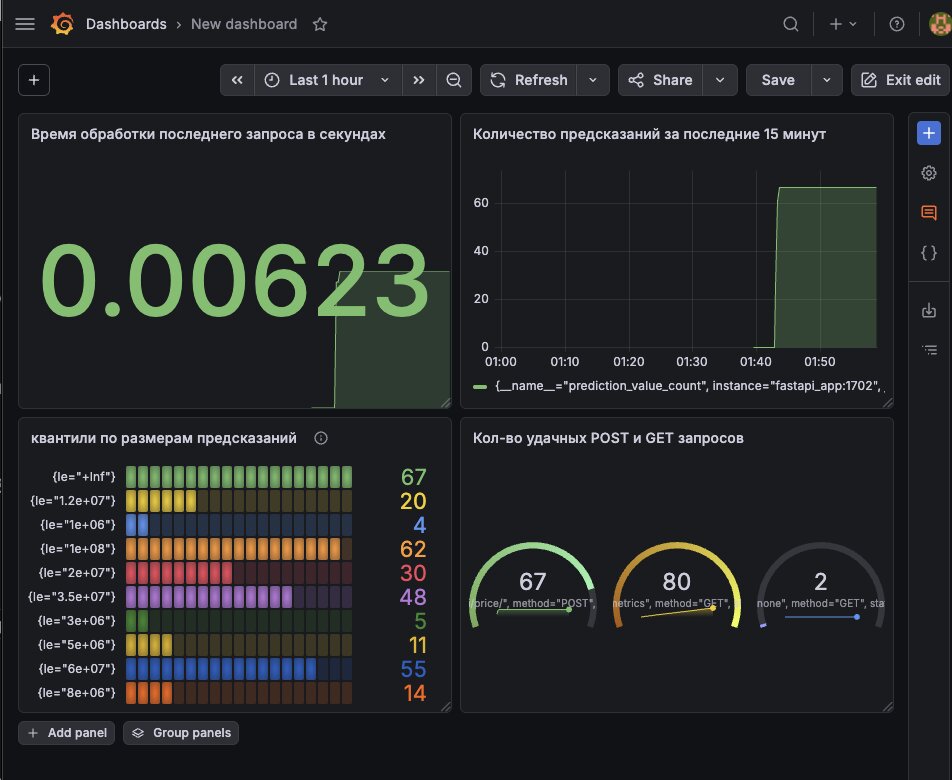
A CatBoost service prices an apartment from 15 inputs. I wired the prediction API to Prometheus and Grafana so requests and predictions can be inspected under simulated load.
CatBoost · Prometheus · GrafanaOpen repository ↗Thoughts
What happens if you shuffle the track codes?
In FourTheRecord, each track gets a four-byte code derived from its audio. Shuffling those codes between tracks keeps the storage cost the same, but breaks the link to the sound. Comparing the two assignments should show how much that link matters for predicting the next track. The comparison is still ahead.
FourTheRecord project notes →Don't miss these papers
- Semantic IDs for Music Recommendation ↗M. Jeffrey Mei et al. · 2025
Abstract
Abstract summaryThe authors study how music recommenders can share representations across tracks using codes derived from audio content. They evaluate the approach on two datasets and in a streaming-service A/B test, reporting improvements in recommendation accuracy and diversity alongside a smaller model.
- Recommender Systems with Generative Retrieval ↗Shashank Rajput et al. · 2023
Abstract
AbstractModern recommender systems perform large-scale retrieval by first embedding queries and item candidates in the same unified space, followed by approximate nearest neighbor search to select top candidates given a query embedding. In this paper, we propose a novel generative retrieval approach, where the retrieval model autoregressively decodes the identifiers of the target candidates. To that end, we create semantically meaningful tuple of codewords to serve as a Semantic ID for each item. Given Semantic IDs for items in a user session, a Transformer-based sequence-to-sequence model is trained to predict the Semantic ID of the next item that the user will interact with. To the best of our knowledge, this is the first Semantic ID-based generative model for recommendation tasks. We show that recommender systems trained with the proposed paradigm significantly outperform the current SOTA models on various datasets. In addition, we show that incorporating Semantic IDs into the sequence-to-sequence model enhances its ability to generalize, as evidenced by the improved retrieval performance observed for items with no prior interaction history.
- Proving and Improving the Platonic Representation Hypothesis with JEPAs ↗Randall Balestriero and Yann LeCun · 2026
Abstract
AbstractWhether models trained on different modalities converge to the same representation of the world is central to AI. The Platonic Representation Hypothesis (PRH) conjectures that they do as they scale, but without a proof it offers neither a guarantee nor a recipe. We turn the hypothesis into a theorem. First, we prove a \emph{Platonic Representation Theorem}: Joint-Embedding Predictive Architectures (JEPAs) trained separately on any number of modalities learn the same representation up to one rotation whenever their positive pairs are two observations of one scene--\emph{good views}--and their misalignment is bounded otherwise. Second, we show that next-token prediction is a JEPA with \emph{bad views}, parts of a single document, which explains why language models align with vision only through scale. Third, we validate the theory from 145k captions to the texts of 940M web images, and uncover a scaling law of alignment that predicts unseen runs within seed noise. Good views need 42 times fewer training samples than next-token prediction on the same corpus to reach the same alignment, and a 109M-parameter text JEPA aligns with DINOv2 and CLIP's image encoders better than every language model we evaluated, up to 72B parameters, and than CLIP's text encoder: next-token prediction is a remarkably inefficient route to platonic representations. As a showcase, one rotation turns separately trained encoders into an image captioner (CIDEr .838 on COCO). Even that rotation needs no pair: on the latest pair-free benchmark, our text JEPA beats every zero-shot accuracy reported with language models up to 8B parameters, e.g., 64% against at most 56% top-5 on ImageNet-100. Positive views, and not scale alone, are thus the lever to build platonic representations.
- Deep Learning to Rank in Industrial Search Engines, Recommender Systems, and Online Advertising: An Overview and New Perspectives ↗Yulong Gu, Lixin Zou and Chenliang Li · 2026
Abstract
AbstractSearch engines, Recommender systems, and Online advertising are playing fundamental roles in modern web and mobile applications. In these information systems, the most significant component is the ranking system, which selects a list of items likely to interest a user from billions of candidate items. At its core, Deep learning to Rank (DLTR) has become indispensable for building high-performance ranking models, driving significant gains in user engagement and business growth. In this article, firstly, we outline the key problems and challenges in industrial-scale ranking systems. Secondly, we provide a comprehensive review of deep learning models deployed across multiple stages of the industrial ranking pipeline, including matching, pre-ranking, fine-grained ranking, post-ranking, and relevance-ranking. Finally, we explore novel perspectives for future research, such as leveraging Large Language Models (LLMs). The papers discussed in this survey are listed in https://github.com/guyulongcs/Awesome-Deep-Learning-Papers-for-Search-Recommendation-Advertising.
- OneRec: Unifying Retrieve and Rank with Generative Recommender and Iterative Preference Alignment ↗Jiaxin Deng et al. · 2025
Abstract
AbstractRecently, generative retrieval-based recommendation systems have emerged as a promising paradigm. However, most modern recommender systems adopt a retrieve-and-rank strategy, where the generative model functions only as a selector during the retrieval stage. In this paper, we propose OneRec, which replaces the cascaded learning framework with a unified generative model. To the best of our knowledge, this is the first end-to-end generative model that significantly surpasses current complex and well-designed recommender systems in real-world scenarios. Specifically, OneRec includes: 1) an encoder-decoder structure, which encodes the user's historical behavior sequences and gradually decodes the videos that the user may be interested in. We adopt sparse Mixture-of-Experts (MoE) to scale model capacity without proportionally increasing computational FLOPs. 2) a session-wise generation approach. In contrast to traditional next-item prediction, we propose a session-wise generation, which is more elegant and contextually coherent than point-by-point generation that relies on hand-crafted rules to properly combine the generated results. 3) an Iterative Preference Alignment module combined with Direct Preference Optimization (DPO) to enhance the quality of the generated results. Unlike DPO in NLP, a recommendation system typically has only one opportunity to display results for each user's browsing request, making it impossible to obtain positive and negative samples simultaneously. To address this limitation, We design a reward model to simulate user generation and customize the sampling strategy. Extensive experiments have demonstrated that a limited number of DPO samples can align user interest preferences and significantly improve the quality of generated results. We deployed OneRec in the main scene of Kuaishou, achieving a 1.6% increase in watch-time, which is a substantial improvement.
- On Embeddings for Numerical Features in Tabular Deep Learning ↗Yury Gorishniy et al. · 2022
Abstract
AbstractRecently, Transformer-like deep architectures have shown strong performance on tabular data problems. Unlike traditional models, e.g., MLP, these architectures map scalar values of numerical features to high-dimensional embeddings before mixing them in the main backbone. In this work, we argue that embeddings for numerical features are an underexplored degree of freedom in tabular DL, which allows constructing more powerful DL models and competing with GBDT on some traditionally GBDT-friendly benchmarks. We start by describing two conceptually different approaches to building embedding modules: the first one is based on a piecewise linear encoding of scalar values, and the second one utilizes periodic activations. Then, we empirically demonstrate that these two approaches can lead to significant performance boosts compared to the embeddings based on conventional blocks such as linear layers and ReLU activations. Importantly, we also show that embedding numerical features is beneficial for many backbones, not only for Transformers. Specifically, after proper embeddings, simple MLP-like models can perform on par with the attention-based architectures. Overall, we highlight embeddings for numerical features as an important design aspect with good potential for further improvements in tabular DL.
- DCN V2: Improved Deep & Cross Network and Practical Lessons for Web-scale Learning to Rank Systems ↗Ruoxi Wang et al. · 2020
Abstract
AbstractLearning effective feature crosses is the key behind building recommender systems. However, the sparse and large feature space requires exhaustive search to identify effective crosses. Deep & Cross Network (DCN) was proposed to automatically and efficiently learn bounded-degree predictive feature interactions. Unfortunately, in models that serve web-scale traffic with billions of training examples, DCN showed limited expressiveness in its cross network at learning more predictive feature interactions. Despite significant research progress made, many deep learning models in production still rely on traditional feed-forward neural networks to learn feature crosses inefficiently. In light of the pros/cons of DCN and existing feature interaction learning approaches, we propose an improved framework DCN-V2 to make DCN more practical in large-scale industrial settings. In a comprehensive experimental study with extensive hyper-parameter search and model tuning, we observed that DCN-V2 approaches outperform all the state-of-the-art algorithms on popular benchmark datasets. The improved DCN-V2 is more expressive yet remains cost efficient at feature interaction learning, especially when coupled with a mixture of low-rank architecture. DCN-V2 is simple, can be easily adopted as building blocks, and has delivered significant offline accuracy and online business metrics gains across many web-scale learning to rank systems at Google.
- On Layer Normalization in the Transformer Architecture ↗Ruibin Xiong et al. · 2020
Abstract
AbstractThe Transformer is widely used in natural language processing tasks. To train a Transformer however, one usually needs a carefully designed learning rate warm-up stage, which is shown to be crucial to the final performance but will slow down the optimization and bring more hyper-parameter tunings. In this paper, we first study theoretically why the learning rate warm-up stage is essential and show that the location of layer normalization matters. Specifically, we prove with mean field theory that at initialization, for the original-designed Post-LN Transformer, which places the layer normalization between the residual blocks, the expected gradients of the parameters near the output layer are large. Therefore, using a large learning rate on those gradients makes the training unstable. The warm-up stage is practically helpful for avoiding this problem. On the other hand, our theory also shows that if the layer normalization is put inside the residual blocks (recently proposed as Pre-LN Transformer), the gradients are well-behaved at initialization. This motivates us to remove the warm-up stage for the training of Pre-LN Transformers. We show in our experiments that Pre-LN Transformers without the warm-up stage can reach comparable results with baselines while requiring significantly less training time and hyper-parameter tuning on a wide range of applications.
- An Introduction to Variational Autoencoders ↗Diederik P. Kingma and Max Welling · 2019
Abstract
AbstractVariational autoencoders provide a principled framework for learning deep latent-variable models and corresponding inference models. In this work, we provide an introduction to variational autoencoders and some important extensions.
- Self-Attentive Sequential Recommendation ↗Wang-Cheng Kang and Julian McAuley · 2018
Abstract
AbstractSequential dynamics are a key feature of many modern recommender systems, which seek to capture the `context' of users' activities on the basis of actions they have performed recently. To capture such patterns, two approaches have proliferated: Markov Chains (MCs) and Recurrent Neural Networks (RNNs). Markov Chains assume that a user's next action can be predicted on the basis of just their last (or last few) actions, while RNNs in principle allow for longer-term semantics to be uncovered. Generally speaking, MC-based methods perform best in extremely sparse datasets, where model parsimony is critical, while RNNs perform better in denser datasets where higher model complexity is affordable. The goal of our work is to balance these two goals, by proposing a self-attention based sequential model (SASRec) that allows us to capture long-term semantics (like an RNN), but, using an attention mechanism, makes its predictions based on relatively few actions (like an MC). At each time step, SASRec seeks to identify which items are `relevant' from a user's action history, and use them to predict the next item. Extensive empirical studies show that our method outperforms various state-of-the-art sequential models (including MC/CNN/RNN-based approaches) on both sparse and dense datasets. Moreover, the model is an order of magnitude more efficient than comparable CNN/RNN-based models. Visualizations on attention weights also show how our model adaptively handles datasets with various density, and uncovers meaningful patterns in activity sequences.
- Deep Interest Network for Click-Through Rate Prediction ↗Guorui Zhou et al. · 2017
Abstract
AbstractClick-through rate prediction is an essential task in industrial applications, such as online advertising. Recently deep learning based models have been proposed, which follow a similar Embedding\&MLP paradigm. In these methods large scale sparse input features are first mapped into low dimensional embedding vectors, and then transformed into fixed-length vectors in a group-wise manner, finally concatenated together to fed into a multilayer perceptron (MLP) to learn the nonlinear relations among features. In this way, user features are compressed into a fixed-length representation vector, in regardless of what candidate ads are. The use of fixed-length vector will be a bottleneck, which brings difficulty for Embedding\&MLP methods to capture user's diverse interests effectively from rich historical behaviors. In this paper, we propose a novel model: Deep Interest Network (DIN) which tackles this challenge by designing a local activation unit to adaptively learn the representation of user interests from historical behaviors with respect to a certain ad. This representation vector varies over different ads, improving the expressive ability of model greatly. Besides, we develop two techniques: mini-batch aware regularization and data adaptive activation function which can help training industrial deep networks with hundreds of millions of parameters. Experiments on two public datasets as well as an Alibaba real production dataset with over 2 billion samples demonstrate the effectiveness of proposed approaches, which achieve superior performance compared with state-of-the-art methods. DIN now has been successfully deployed in the online display advertising system in Alibaba, serving the main traffic.
- Deep & Cross Network for Ad Click Predictions ↗Ruoxi Wang et al. · 2017
Abstract
AbstractFeature engineering has been the key to the success of many prediction models. However, the process is non-trivial and often requires manual feature engineering or exhaustive searching. DNNs are able to automatically learn feature interactions; however, they generate all the interactions implicitly, and are not necessarily efficient in learning all types of cross features. In this paper, we propose the Deep & Cross Network (DCN) which keeps the benefits of a DNN model, and beyond that, it introduces a novel cross network that is more efficient in learning certain bounded-degree feature interactions. In particular, DCN explicitly applies feature crossing at each layer, requires no manual feature engineering, and adds negligible extra complexity to the DNN model. Our experimental results have demonstrated its superiority over the state-of-art algorithms on the CTR prediction dataset and dense classification dataset, in terms of both model accuracy and memory usage.
- CatBoost: unbiased boosting with categorical features ↗Liudmila Prokhorenkova et al. · 2017
Abstract
AbstractThis paper presents the key algorithmic techniques behind CatBoost, a new gradient boosting toolkit. Their combination leads to CatBoost outperforming other publicly available boosting implementations in terms of quality on a variety of datasets. Two critical algorithmic advances introduced in CatBoost are the implementation of ordered boosting, a permutation-driven alternative to the classic algorithm, and an innovative algorithm for processing categorical features. Both techniques were created to fight a prediction shift caused by a special kind of target leakage present in all currently existing implementations of gradient boosting algorithms. In this paper, we provide a detailed analysis of this problem and demonstrate that proposed algorithms solve it effectively, leading to excellent empirical results.
- Deep Neural Networks for YouTube Recommendations ↗Paul Covington, Jay Adams and Emre Sargin · 2016
Abstract
AbstractYouTube represents one of the largest scale and most sophisticated industrial recommendation systems in existence. In this paper, we describe the system at a high level and focus on the dramatic performance improvements brought by deep learning. The paper is split according to the classic two-stage information retrieval dichotomy: first, we detail a deep candidate generation model and then describe a separate deep ranking model. We also provide practical lessons and insights derived from designing, iterating and maintaining a massive recommendation system with enormous userfacing impact.
- Generative Adversarial Networks ↗Ian J. Goodfellow et al. · 2014
Abstract
AbstractWe propose a new framework for estimating generative models via an adversarial process, in which we simultaneously train two models: a generative model G that captures the data distribution, and a discriminative model D that estimates the probability that a sample came from the training data rather than G. The training procedure for G is to maximize the probability of D making a mistake. This framework corresponds to a minimax two-player game. In the space of arbitrary functions G and D, a unique solution exists, with G recovering the training data distribution and D equal to 1/2 everywhere. In the case where G and D are defined by multilayer perceptrons, the entire system can be trained with backpropagation. There is no need for any Markov chains or unrolled approximate inference networks during either training or generation of samples. Experiments demonstrate the potential of the framework through qualitative and quantitative evaluation of the generated samples.
- Auto-Encoding Variational Bayes ↗Diederik P Kingma and Max Welling · 2013
Abstract
AbstractHow can we perform efficient inference and learning in directed probabilistic models, in the presence of continuous latent variables with intractable posterior distributions, and large datasets? We introduce a stochastic variational inference and learning algorithm that scales to large datasets and, under some mild differentiability conditions, even works in the intractable case. Our contributions are two-fold. First, we show that a reparameterization of the variational lower bound yields a lower bound estimator that can be straightforwardly optimized using standard stochastic gradient methods. Second, we show that for i.i.d. datasets with continuous latent variables per datapoint, posterior inference can be made especially efficient by fitting an approximate inference model (also called a recognition model) to the intractable posterior using the proposed lower bound estimator. Theoretical advantages are reflected in experimental results.
Technologies
Languages & data
Machine learning
Engineering & infrastructure
Internship
- AI-engineer intern Jun–Oct 2026
- During my internship at the "SAPPHIRE" agency (Skolkovo) I built data ETL pipelines and agentic workflows via LangGraph and LangSmith to track AI development in Russia.
Hackathons
- AlfaFuture, Alfa-Bank Oct 2026
- I worked on customer embeddings for a lending dashboard and fine-tuned Qwen3.5-4B with PEFT.
- Technoforge AgroTECH Autumn 2025
- Our team took third place. I trained gradient boosting models to recommend dairy cow diets for a target milk fatty acid profile.
Languages
- English
- C1 (IELTS)
- German
- B2 (Goethe-Zertifikat)